Managing the Metadata Cache
DbVisualizer keeps a cache of the database metadata, such as schema, table and column names, to make features like auto completion and table data editing faster. The cache doesn't store table data or other sensitive information.
Configuring the metadata cache
The metadata cache can be set to any of these modes:
- Persistent (default): The metadata is stored locally and reused in new sessions.
- Shared: The metadata is stored locally and shared between DbVisualizer instances that run at the same time.
- Transient: The metadata is cleared for each new session.
- Disabled: The cache is not used.
With Stale Content Threshold, you set after how many days unused metadata is removed from the cache. The default is 60 days, and 0 turns it off.
You find the settings in Tools → Tool Properties, in the Database Connection / Metadata category under the General tab.
Refreshing the metadata cache
When the database structure has been changed outside DbVisualizer or by scripts, you may need to refresh the cache. You can do this for all connections, for one connection, or for parts of a connection.
Using the File menu
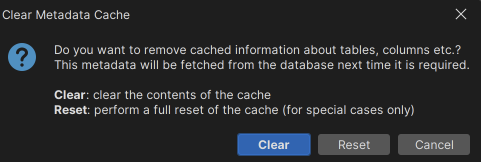
Select File → Clear Cache, and select a connection, or Clear All for all connections. For Clear All, you are asked to select Clear or Reset. Reset removes and recreates the whole cache; only use it if there are problems with the cache.
Using the Databases tab
Right-click a node in the Databases tab and select Refresh Objects Tree. When the node contains tables, the cached metadata for the database is cleared. The catalog and schema lists in SQL Commander are also updated.
Using the auto-complete popup
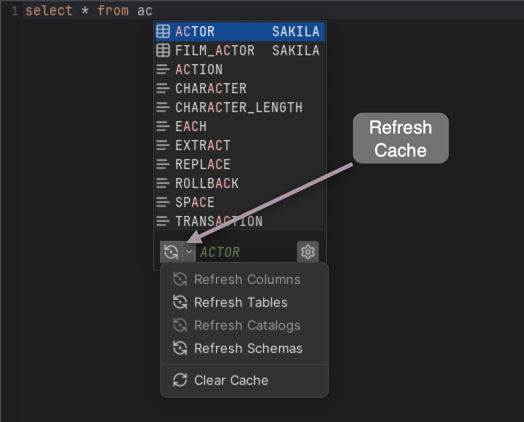
The auto-complete popup in SQL Commander has a refresh button, which is useful when the popup doesn't match the database. By default, it refreshes what the popup shows, such as tables or columns. In its drop-down menu, you can instead refresh the tables, columns, catalogs or schemas, or clear the cache as with File → Clear Cache. Which items are available depends on the caret position and the database.