There’s no doubt that the AI revolution is already here. These days, you will hardly find a developer that’s not using AI. Chatbots like Gemini, ChatGPT, and others are so prevalent that even universities are cashing in on the revolution and offering Bachelor’s degrees in AI management.
Regardless of what you’d think about AI, it’s here and it’s likely here to stay and that’s why even the most prominent database vendors are not only implementing vector search and other capabilities into their database management systems, but shining a spotlight on AI as well.
Let’s see how MariaDB is preparing itself for AI!
Why Care About MariaDB?
First off, why should you still care about MariaDB? The database continues to evolve through actively maintained long-term support releases, including MariaDB 11.8 and the newer MariaDB 12.3 LTS.
Recent MariaDB releases have focused on performance, stability, and capabilities for modern application development. One of the most notable additions is native vector search, which became generally available with MariaDB 11.8 and lets developers store and search vector embeddings directly alongside relational data without requiring a separate vector database or extension.
Together with improvements across areas such as query optimization, replication, and JSON support, these additions show how MariaDB is continuing to adapt to workloads that increasingly incorporate AI and machine learning.
How MariaDB Prepared Itself for AI
Engines and Vector Search
MariaDB already had a lot of things up its sleeve even before the birth of ChatGPT and related AI chatbots: remember ColumnStore? It is one of the storage engines within the MariaDB ecosystem widely used to store vector embeddings and other AI-related data to this day and AI didn’t shift into its ecosystem from nowhere.
Even in 2024, Vicentiu, the CDO of MariaDB, has made an announcement that referenced the power of the MariaDB vector when developing AI-powered applications.
MariaDB had started preparing itself for the AI era early on: as Vicentiu notes in his announcement-guide, MariaDB can be considered a vector database, and since 2024, users of MariaDB can modify the code of their applications for it to query a vector embedding model to insert vector embeddings into MariaDB.
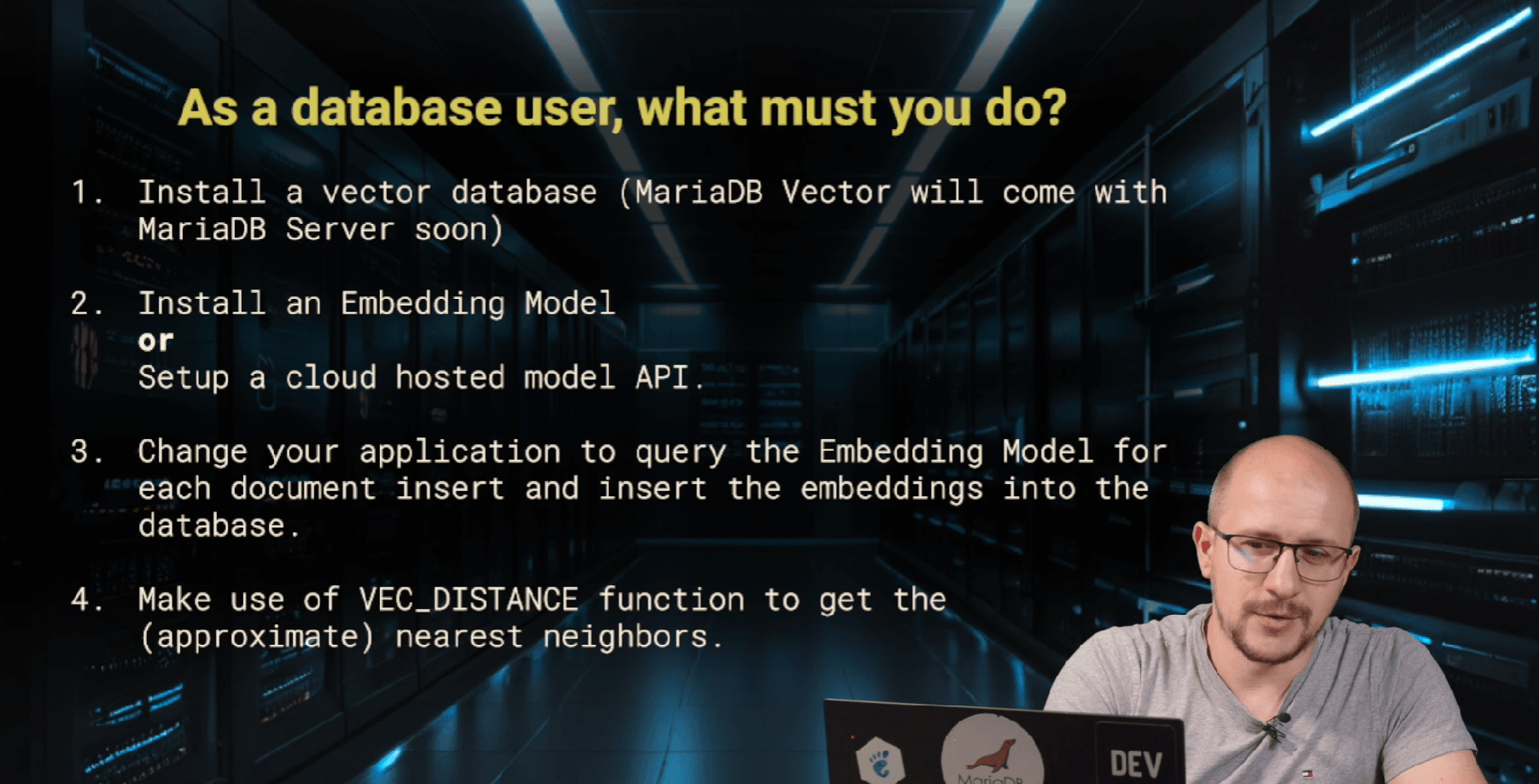
Users of MariaDB can now make use of the VEC_DISTANCE function to acquire the approximate nearest neighbors and perform a vector search when necessary.
Indeed, this function is not the only one related to vector embeddings either: according to the MariaDB documentation, so far there are 5 functions that help developers manipulate and query vector data types inside of MariaDB - one can be used to calculate the distance between vector embeddings, another one can calculate the cosine or Euclidean distances between them, another one can convert vector embeddings to text.
Aside from that, vector search has been upgraded to utilize indexing for high-performance too.
With this, MariaDB has leveraged their existing capabilities to adhere to the requests of their community involving developers that are heavy on AI and use vector search functionalities together with it.
MariaDB Cloud
Vector searching isn’t the only way how MariaDB had prepared itself for the AI revolution: MariaDB Cloud now includes preconfigured AI copilots (agents) that can assist with query generation and even database management tasks, helping developers write queries and troubleshoot performance without DBAs.
Acquisitions
MariaDB is also known for acquiring certain tools that make their ecosystem more powerful. In an AI context, these tools include, but are not limited to the GridGain acquisition enabling in-memory data processing in milliseconds which is critical for AI-assisted applications and systems that modify and work on data in real-time. MariaDB also brought back SkySQL.
What Else?
Aside from acquisitions, there are rumors that MariaDB has launched a unified cloud database platform for AI developers: according to multiple sources on the Web, additions of copilots inside of the cloud database platform now allows AI agents to connect with data and developers to “talk” to it for insights and easier data management.
Conclusion
MariaDB has prepared itself for the AI era by coming up with a lot of ingenious upgrades involving updates to data types (think MariaDB Vector), MariaDB Cloud, and other things, and there is no doubt that the MariaDB team has something else up their sleeves as well.
Many users of MariaDB have smelled AI support even in early 2023 with vector search being in development, and now that it’s done and other features are on the way, the team is preparing for something even bigger.
From storage engines and vector search to acquisitions, AI-augmented developers can now peruse MariaDB to solve more of their issues than ever before and that can be augmented by using SQL clients like DbVisualizer as well.
SQL clients like DbVisualizer and their counterparts also come with AI assistants meaning that even if you’re not a user of MariaDB or its counterpart MySQL, you will still benefit from using the client. Why not give it a try today?
FAQ
How did MariaDB prepare itself for the AI era?
MariaDB has prepared itself for the AI era by leveraging old things like the ColumnStore storage engine, developing new features (think vector search), working on the MariaDB Cloud and acquiring a bunch of tools that help the team do just that.
Can I use vectors with MariaDB?
If your AI-assisted project necessitates vector search or vector embeddings, yes, you can peruse them inside of MariaDB as well. In fact, vector data types now come pre-installed with MariaDB, so ensure you use newer versions of the DBMS and you should not have any issues.