intro
There’s no doubt that SQL is the primary language for data analysts. Plain SQL, though, is unlikely to get you far: read this blog and learn multiple advanced techniques you can employ when dealing with your data.

Once the topic of SQL data analytics comes up in conversation, you can be sure that many people will provide their input. Some will say that it is nothing revolutionary, others will argue that data analytics is the greatest invention of the century. Regardless, if you find yourself using SQL for data analytics purposes, there are few techniques you should know. Let’s discover them!
5 Advanced Techniques for SQL Data Analytics
Take a look at the five most important SQL data analytics approaches and techniques you need to know.
Data Parsing
For many, the most important data analytics technique in SQL would likely be parsing. Parsing refers to “cleaning” a data set in your possession so that the data set adheres to specific requirements or guidelines.
SQL queries that assist in parsing can vary as per your requirements and specific specifications. Some of you may need to return everything after the “@” part for email addresses, some of you may need to return specific sales data by looking at the date the sale was made, etc.
Regardless, parsing helps you to take data in one format and turn it into data that follows another format. Some columns may need to be ignored, others will stay in place. An SQL query involving SUBSTRING like the one below would return the domain part for email addresses:
                    1
                    SELECT email, SUBSTRING(email, LOCATE('@', email) + 1) AS domain_part FROM users
Execute it on a visual database client like DbVisualizer, and you would get:

Other SQL queries will result in different outcomes.
Window Functions
Next up, we’d have SQL window functions. Window functions are powerful tools that allow us to perform calculations related to a set of rows. Window functions come with the OVER() SQL function and look like so:
                    1
                    SELECT col_1, col_2, col_3 OVER (function) AS something FROM table;
Assume we have a products table and we want to assign a unique sequential number to each row in the result set. We would run an SQL query like so:
                    1
                    SELECT


                    2
                    ROW_NUMBER() OVER (ORDER BY product_id) AS row_num,


                    3
                    product,


                    4
                    product_code


                    5
                    FROM products;
This SQL query would tell our database that we want to return our products, their codes, as well as row numbers and the outcome would be as follows:
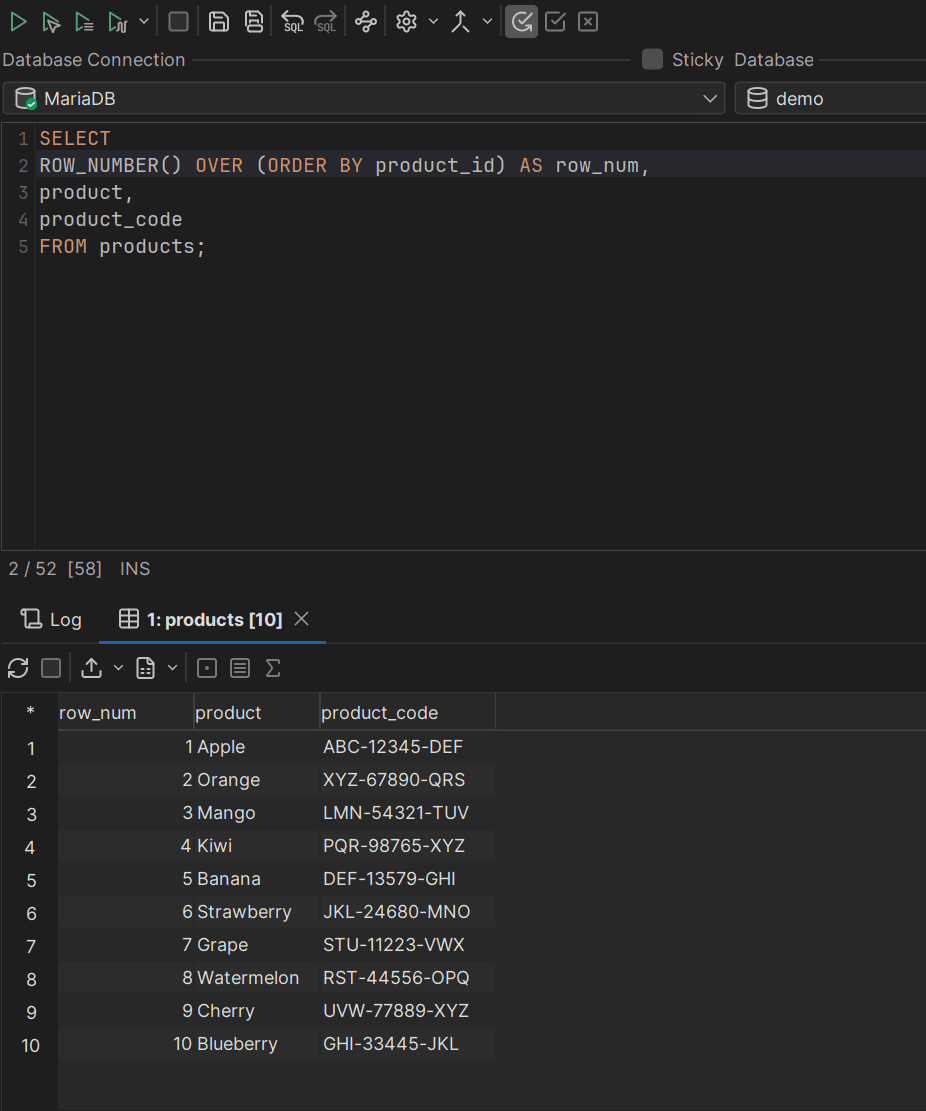
In this case, the row_num column would simply act as an ID column, but the use cases of window functions can vary. One can perform aggregations over windows using aggregate functions like SUM(), AVG(), MIN(), MAX(), and the like.
Window Frame Specifications
When following an SQL data analytics approach, we have another powerful tool: window frame specifications. SQL window frame specifications define which rows are included in a calculation involving our current row, thus enabling more precise and flexible analytics.
                    1
                    SELECT


                    2
                    product_id,


                    3
                    product,


                    4
                    AVG(product_id) OVER (


                    5
                    ORDER BY product_id


                    6
                    ROWS BETWEEN 2 PRECEDING AND CURRENT ROW


                    7
                    ) AS moving_avg_rows


                    8
                    FROM products;
This SQL query computes the average of product_id for the current row, and also two previous rows if they exist. (If you use DbVisualizer to run queries like these, also consider formatting them so that they look nice)

While this kind of query may not be relevant if you have less than a thousand rows, it would be useful for analyzing trends or smoothing out data in sequential order.
Partitioned Calculations
Another data analytics SQL technique would be that of partitioned calculations to perform calculations against groups of data. An SQL query like so would return the category and products as well as sum of sales by category from sales data:
                    1
                    SELECT


                    2
                    category,


                    3
                    product_id,


                    4
                    product,


                    5
                    SUM(sales) OVER (PARTITION BY category) AS category_total_sales


                    6
                    FROM sales_data;
Partitioned calculations use the OVER SQL clause with PARTITION BY as well as a column they partition data by.
Percentiles and Distributions
Last but not least, we can use percentiles and distributions to help us find percentile ranks or divide data into buckets. An SQL query like so would assign a “rank” to each product by its price and even though it is unlikely to look nice (percentiles and distributions return numeric values from 0 to 1 with a lot of numbers after the comma) it’d be very useful for analytics:
                    1
                    SELECT


                    2
                    product_id,


                    3
                    product,


                    4
                    PERCENT_RANK() OVER (ORDER BY price) AS percentile_rank


                    5
                    FROM products;

Summary
In this blog, we’ve walked you through a variety of SQL data analytics techniques that will help you in your daily work. No matter if you find yourself parsing data, using window functions or window frame specifications, partitioned calculations or percentiles and distributions, SQL data analytics techniques have something for everyone.
Data analytics in SQL becomes much easier with a full-featured database client that offers visual capabilities for data exploration, such as DbVisualizer. It includes several powerful features, including Excel-like data manipulation in tables, ERD-style schema visualization, simplified data import/export, and much more. Try DbVisualizer today!
We hope that you’ve found this blog to be informational and useful, follow TheTable for more blogs on data analytics and database performance, and until next time.
FAQ
What are some advanced techniques useful to achieve goals related to SQL data analytics?
Advanced techniques for SQL data analytics include data parsing, window functions and window frame specifications, partitioned calculations, and also percentiles and distributions.
Why do I need SQL data analytics?
SQL data analytics is an important part of any data strategy because they involve SQL queries that help us analyze and dig into data to make decisions impacting our business, database, application, or all three of them combined.