SQL

SQL Interview Questions and Answers: Part 3: Tackling Advanced Scenarios

intro

In this blog about SQL interview questions, we’re looking into how to deal with advanced scenarios involving your data.

Tools used in the tutorial
Tool Description Link
Dbvisualizer DBVISUALIZER
TOP RATED DATABASE MANAGEMENT TOOL AND SQL CLIENT

Welcome back. This is the third part of blogs on SQL interview questions and answers. In this blog, we’re going to look into what you can do and how to answer questions in relation to advanced scenarios involving your database.

Why Ask About Advanced Use Cases?

Depending on the role you’re interviewing for, advanced use cases involving a database management system may or may not be out of the question. Hiring managers may want to know your acumen around advanced use cases involving a database because:

  1. It lets them gauge your technical proficiency in a specific database technology. A developer that is well-rounded in advanced use cases involving database management systems is less likely to get lost when bigger problems arise.
  2. Such questions let hiring managers gauge your efficiency in handling complex data operations. In many roles, especially those involving big data or high-traffic applications, you would be expected to manage large datasets and perform operations without thinking twice. For that reason, interviewers may assess your ability to design optimized queries under a database that’s a lot of stress to ensure that their databases will be able to handle large data sets without slowing down.
  3. Questions like these help address potential scalability concerns. As businesses grow, their databases need to scale. Such questions help hiring managers probe your ability to design databases and applications behind them that can handle thousands of users, more and more data, or both. Your ability to set up and manage replication, sharding, or partitioning to distribute workloads can be crucial for the role.

What Questions to Expect and Why?

Now towards the questions themselves. What questions to expect heavily depends on the role you’re applying to.

Those of you applying to Senior developer roles may have a set of questions related to applications, while DBAs may expect more database and infrastructure-focused probes. On the other hand, DevOps engineers can expect different questions altogether.

Here’s what’s likely to happen!

Question Topic #1: Architecture and Backups

You saw this one coming, didn’t you? Architecture and backup-related questions are likely to be at the top of the list. Basics are out of the question: you should know your way around normalization, partitioning, and indexing as-is.

However, you may be hit with questions like can you explain the differences and trade-offs between monolithic and microservices architectures? Which one would you choose for a large-scale application and why? How do you perform a backup on a big data application bearing 15 billion rows so that it can be recovered without huge impact on those using the application?

These kinds of questions help hiring managers to understand your thinking and logic when it comes to database architecture, your understanding of monolithic and microservice-based architectures, and backing up data. In this regard, keep in mind that a monolithic architecture refers to all of the application being built as a single unit. In such an approach, all components run together.

A classic example of a microservices-based architecture, though, would be something like Docker. In such an architecture, each service can be independently scaled, and even if one service would fail, it wouldn’t bring down the entire application. So, a monolithic architecture comes with simplicity, but flexibility limitations, while a microservice-based architecture comes with scalability and more resilience, but with more deployment overhead and complexity to manage.

As far as backups on big data are concerned, you would need to consider the exact use case, but in general, in a relational database management system, you would back up big data sets by backing up raw data because it doesn’t come with overhead (that can’t be said about INSERT statements).

The same goes for recovery: if you recover raw data, there’s little overhead so even if the users of your application would be impacted (let’s be honest, if you’re recovering billions of rows, someone will feel the impact), everything would be over quickly.

Question Topic #2: Queries

This one is closely related to architecture and backups. Most hiring managers and developers checking your work will likely assume that you already know your way around SQL query optimization, but at the same time, you would be asked about query refactoring, rewriting, eliminating unnecessary parts from them, reducing the use of functions in WHERE and other kinds of clauses, and optimizing some parts of complex queries.

When answering complex questions about SQL queries, keep in mind that solutions to problems don’t necessarily have to be complex. In fact, some of the questions that you will receive can be solved in the easiest of ways.

To refactor a query, simplify complex expressions by:

  1. Remove unnecessary joins. If a query joins tables that aren’t contributing to the result, why query them in the first place?
  2. Avoid subqueries when possible. Consider converting subqueries into JOIN or other types of queries or make use of CTEs when possible.
  3. Replace OR with IN. If you have multiple OR conditions, consider replacing them with a single IN clause.
  4. See if UNION is even necessary. The SQL UNION operator joins the results of two or more queries together, but the problem with it is that all tables that are joined must have the same number of columns. It’s also easy to get wrong as one WHERE clause only applies to that specific table, not all of them.

Also, keep in mind to:

  • Avoid SELECT * : Opt for SELECT column instead. Selecting everything in a table is often not the best decision as queries like SELECT * don’t always make use of optimizations like indexing, normalization, and the like.
  • Make use of the EXPLAIN and similar clauses: Database management systems like MySQL and PostgreSQL have EXPLAIN and similar clauses to help you understand how your database thinks when executing a SQL query. When refactoring, understanding how your database thinks is key. Make use of EXPLAIN and similar clauses to refactor your queries.
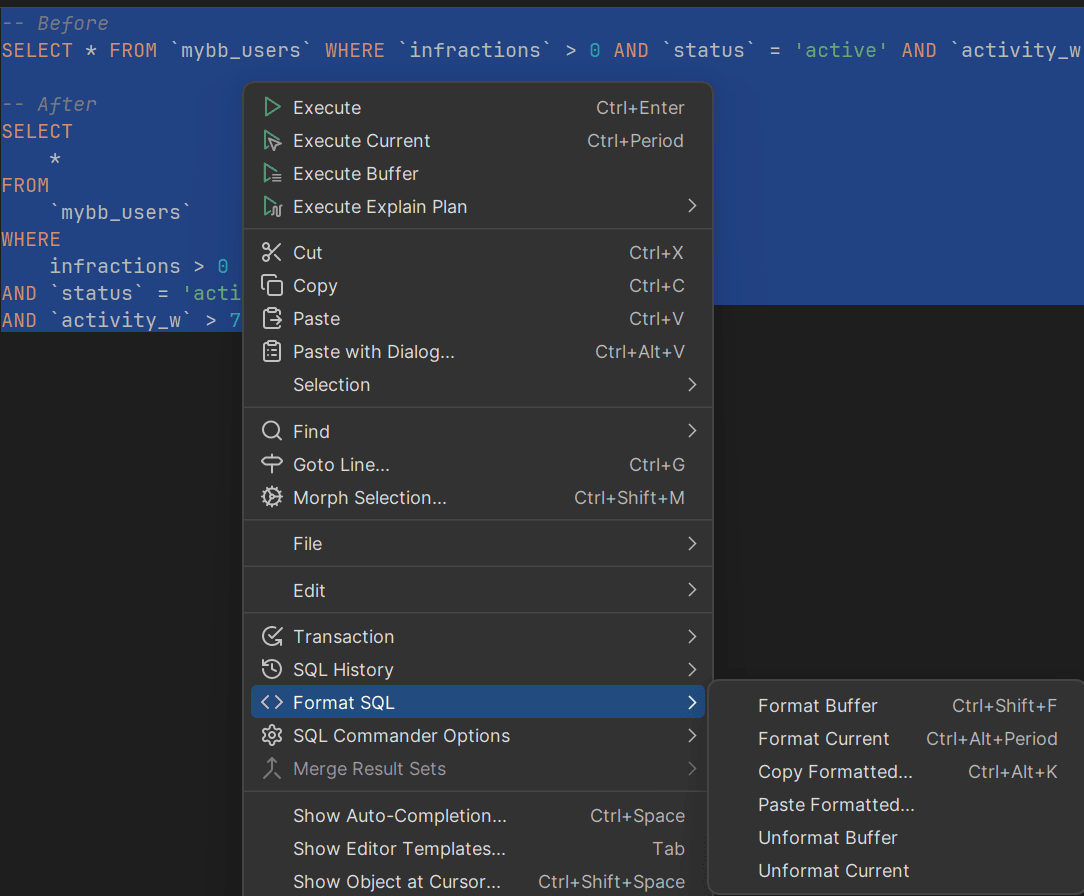
  • Group related conditions: When complex conditions are involved, grouping similar conditions together is key to improve readability and clarity. SQL clients like DbVisualizer can also play a key role in improving clarity in your database operations: enter a query, mark it, then click on “Format SQL” for it to look nicer. Much easier to understand, isn’t it?
The Format SQL option in DbVisualizer
The “Format SQL” option in DbVisualizer

Question Topic #3: Transactions and Isolation Levels

Another topic that’s closely related to queries would be related to transactions. Think about it, every query should be a part of a transaction, right?

When considering such questions, keep in mind that you would be likely pressed on rollbacks, deadlocks, isolation levels and other considerations, and to answer them, keep in mind that:

  1. Each query is a transaction. To prevent a database from “saving” their results (committing) every time they’re completed, you can turn off autocommit (set autocommit to 0), and then COMMIT once you finish all of the INSERT, UPDATE , or other operations.
  2. The main isolation levels are Read Uncommitted, Read Committed, Repeatable Read, and Serializable. Read uncommitted allows dirty reads, read committed allows non-repeatable reads, repeatable read allows phantom reads, serializable doesn’t permit either and provides the highest level of consistency.
  3. Higher isolation levels reduce concurrency. At the same time, they ensure greater data integrity, while lower isolation levels allow higher concurrency but may lead to issues like dirty reads or phantom reads.

Question Topic #4: SQL Clients

You’re unlikely to handle complex topics alone. The terminal, your colleagues, and phpMyAdmin will surely help, but if you are interviewing for a mid-level+ position, be advised that phpMyAdmin is ill-equipped to handle all scenarios. You can hack something together, but doing that every time you need to solve an issue would be overkill.

To obtain answers to most of your issues, you would also turn to SQL clients like DbVisualizer. Take a look at the screenshots before the third question topic: having bigger queries to deal with, would you like to format them manually? Having 100+ columns in a DBMS, would you like to click on each and every one of them to find out what data types they’re based on?

Another thing that SQL clients like DbVisualizer will help you with is to stop worrying about the database management system you’re using: with support for 50+ data sources, you will surely find your database management system in the list as well. DbVisualizer comes with:

  • An advanced SQL query editor with code completion. Perhaps one of the most widely used features within the SQL client is its SQL query editor that can format and automatically complete your queries for you. It won’t get rid of all of your problems concerning SQL queries (as you will still have to do the majority of the work yourself) but it will set you on the right path in terms of executing them.
  • A visual query builder. The client lets you drag-and-drop tables to create queries in a visual way, hence the name.
  • The ability to analyze execution plans. DbVisualizer also provides a viewer of the execution plan helping you analyze how exactly SQL queries are being executed by your database of choice. An execution plan outlines the steps the engine behind your database will take to retrieve or modify the data, including how tables are accessed, which indexes are used, and the join methods applied.
  • Advanced data import and export options. When using DbVisualizer, you will know that data can be imported and exported in a variety of ways including CSV, Excel, and SQL scripts. That can be useful if your use case involves search engines that act on data and you need to import or export data in formats other than SQL.
  • Cross-platform support. DbVisualizer is available for Windows, Linux, and macOS.

DbVisualizer comes with many other features unique to itself, but we’ll leave them up to you to explore in full; do that and come back for the last, fourth, episode of SQL interview questions and answers later on.

Summary

In the third part of SQL interview questions and answers, we’ve looked into a bunch of advanced scenarios that may be involved in your next interview for a role. We’ve touched upon database architecture, backups for billions of rows, simplifying queries and operations, transactions and isolation levels, and SQL clients like DbVisualizer.

You would inevitably need to add or modify the steps within those outlined looking at your use case. But we hope that by providing you some information about these steps, we’ve put you on the right track in terms of passing your upcoming SQL interview.

Do keep in touch with us through our blog or through X/Twitter, read books pertaining to your specific DBMS of choice, and until next time.

Dbvis download link img
About the author
LukasVileikisPhoto
Lukas Vileikis
Lukas Vileikis is an ethical hacker and a frequent conference speaker. He runs one of the biggest & fastest data breach search engines in the world - BreachDirectory.com, frequently speaks at conferences and blogs in multiple places including his blog over at lukasvileikis.com.
The Table Icon
Sign up to receive The Table's roundup
More from the table
Title Author Tags Length Published
title

How to Delete Duplicate Rows in SQL?

author Lukas Vileikis tags SQL 6 min 2026-09-21
title

SQL vs NoSQL Databases: A Practical Guide to Choosing the Right Database for Your Use Case

author Leslie S. Gyamfi tags Database system NOSQL SQL 13 min 2026-09-14
title

SQL for Data Analytics: 5 Advanced Techniques You Should Know

author Lukas Vileikis tags MySQL SQL 5 min 2026-09-07
title

Understanding and Using the MOD Function in SQL

author Antonello Zanini tags MySQL ORACLE POSTGRESQL SQL SQL SERVER 8 min 2026-08-31
title

Ensuring HIPAA Compliance in a Changing Data Landscape

author Lukas Vileikis tags SQL 5 min 2026-08-24
title

What Is a Composite Key in SQL and When to Use It

author Antonello Zanini tags MySQL ORACLE POSTGRESQL SQL SQL SERVER 8 min 2026-08-17
title

Best Practices for Using Git with Your Database

author Lukas Vileikis tags SQL 6 min 2026-07-27
title

Understanding SQL Index Maintenance in Open Source Databases

author Lukas Vileikis tags SQL 6 min 2026-06-22
title

INSERT INTO … SELECT Statement: What You Need to Know

author Antonello Zanini tags MySQL ORACLE POSTGRESQL SQL SQL SERVER 6 min 2026-06-15
title

Parsing Data with SUBSTRING_INDEX: A Complete Guide

author Lukas Vileikis tags MARIADB MySQL SQL 5 min 2026-06-08

The content provided on dbvis.com/thetable, including but not limited to code and examples, is intended for educational and informational purposes only. We do not make any warranties or representations of any kind. Read more here.