intro
Let's learn everything you need to know about the composite key SQL mechanism, including how and when to use it as a primary key, unique key, or foreign key.

SQL keys can be thought of as synonymous with indexes, but in this blog, we will looking at a composite key as a set of fields that uniquely identify an entity. With that clarified, by the end of this article, you will understand why SQL composite keys exist, when to use them, and how to define them. Let’s dive in!
Composite Key: Definition and Purpose
A composite key is a as set of fields that uniquely identify an entity. In other words, a composite key represents the combination of fields that serve as a unique identifier in the conceptual model (essentially, the candidate key). In the logical model, this concept can be implemented either as a composite primary key or a composite UNIQUE index.
Database administrators typically rely on composite keys when no single column can guarantee uniqueness, or when they prefer not to add an auto-increment column (e.g., id). By combining columns, a composite key provides a unique identifier for each row, improving data integrity and supporting efficient retrieval.
After all, in conceptual data models, some entities naturally require composite keys to guarantee uniqueness. At the physical database level, database designers can either implement the composite key directly or introduce a surrogate auto-increment ID column, usually turning the identified set of columns to get uniqueness into an SQL UNIQUE constraint. Both approaches are valid, each with its pros and cons (expanded later in a dedicated FAQ).
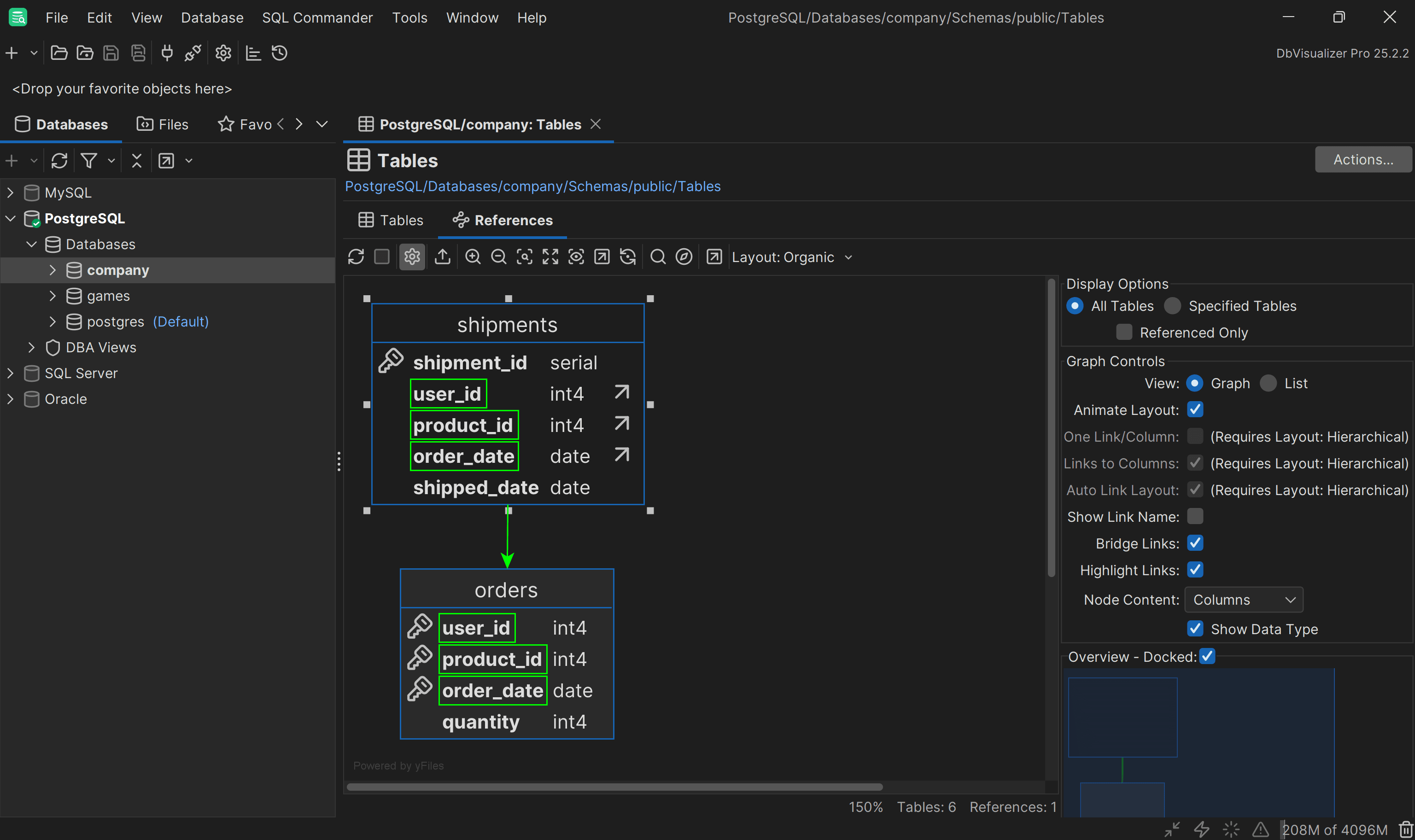
In SQL, composite keys can also be used as primary keys or foreign keys. For example, in an orders table, (user_id, product_id, order_date) may form a composite primary key (or be implemented as a regular composite key via a multi-column UNIQUE index). Then, in a shipments table, shipment_id is the primary key, while (user_id, product_id, order_date) serves as a composite foreign key referencing the orders table.
For an easier understanding, you can visually see the relationship between the orders and shipments tables in a full-featured database client like DbVisualizer:
Composite Keys in the Main Databases
All major databases (MySQL, PostgreSQL, SQL Server, and Oracle) share the same standard syntax for defining composite keys:
                    1
                    CREATE TABLE orders (


                    2
                            id DATA_TYPE PRIMARY KEY,


                    3
                        column_1 DATA_TYPE,


                    4
                        column_2 DATA_TYPE,


                    5
                        ...


                    6
                        column_n DATA_TYPE,


                    7
                        ...


                    8
                        column_m DATA_TYPE,


                    9
                        UNIQUE (column_1, column_2, ..., column_n),


                    10
                    );
Instead, if you need a composite primary key, you will write:
                    1
                    CREATE TABLE orders (


                    2
                        column_1 DATA_TYPE,


                    3
                        column_2 DATA_TYPE,


                    4
                        ...


                    5
                        column_n DATA_TYPE,


                    6
                        ...


                    7
                        column_m DATA_TYPE


                    8
                        PRIMARY KEY (column_1, column_2, ..., column_n)


                    9
                    );
As you can see, this is just like the regular syntax for defining primary keys, except that within the parentheses you specify a comma-separated list of columns instead of a single column. In general, a composite key in SQL consists of a subset, with two or more elements, of the columns in a given table.
For example, a real-world CREATE TABLE composite primary key example query is:
                    1
                    CREATE TABLE orders (


                    2
                        user_id INT,


                    3
                        product_id INT,


                    4
                        order_date DATE,


                    5
                        price DECIMAL(10,2),


                    6
                        status VARCHAR(50),


                    7
                        payment_method VARCHAR(50),


                    8
                        PRIMARY KEY (user_id, product_id, order_date)


                    9
                    );
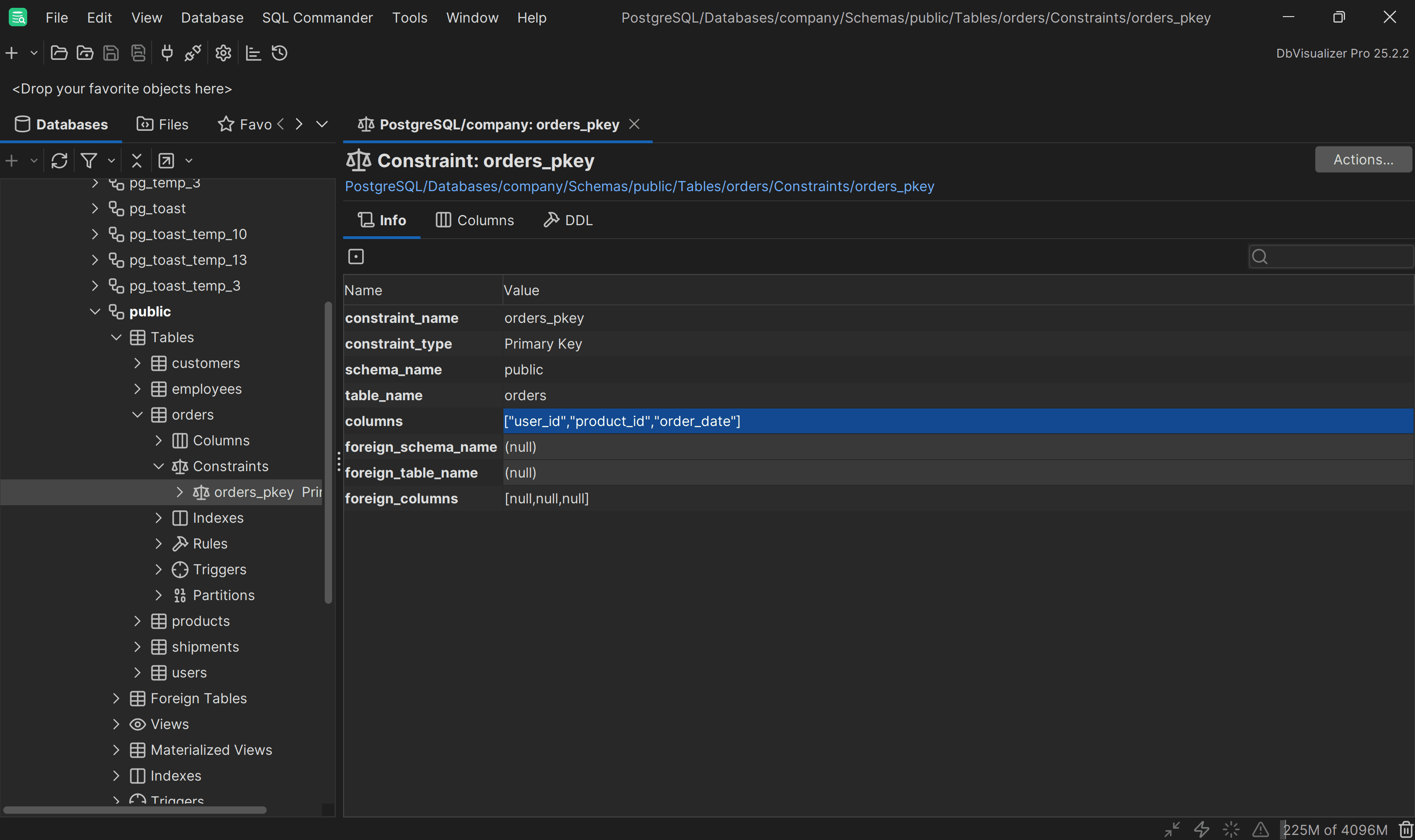
Here, the combination (user_id, product_id, order_date) forms the composite primary key of the orders table. Keep in mind that user_id could be a foreign key referencing users, and product_id a foreign key referencing products.
The DBMS will automatically create the primary key constraint on the specified columns with a default name, which you can verify in a multi-database visual database client:
Remember that this was just an example, but composite keys do not necessarily have to be primary keys.
Notes:
When to Use a Composite Key in SQL
As a rule of thumb, composite keys are employed when a single column cannot uniquely identify each row in a table, and you want to avoid introducing a surrogate auto-increment or special ID column. Explore the top realistic use cases where composite keys are particularly useful!
Note: For simplicity, the examples below refer to composite primary keys, but they can easily be adapted to generic composite keys using multi-column UNIQUE indexes.
Many-to-Many (N-N) Relationships
Many-to-many relationships are represented using junction tables, where each row contains the foreign keys of the related entities. In this case, a composite key consisting of all the foreign key columns is sufficient to guarantee uniqueness.
Note: Adding a surrogate auto-increment ID is generally unnecessary, as you typically do not need to reference individual linking records as foreign keys in other tables. Using a composite key in this scenario keeps the design simple and aligned with the natural relationships.
Example:
Consider a students table and a courses table. A student can enroll in multiple courses, and a course can have multiple students. The enrollments table uses (student_id, course_id) as a composite primary key. This guarantees that the same student cannot enroll in the same course twice while maintaining the natural relationship between students and courses.
                    1
                    CREATE TABLE enrollments (


                    2
                        student_id INT,


                    3
                        course_id INT,


                    4
                        enrollment_date DATE,


                    5
                        PRIMARY KEY (student_id, course_id)


                    6
                    );
Natural Unique Identification Across Multiple Fields
Sometimes a single column cannot uniquely identify a row, but a combination of columns does. Using a composite key preserves natural data meaning.
Example:
In an orders table for an e-commerce platform, a combination of (user_id, product_id, order_date) can serve as the composite primary key. This ensures that a user cannot place the same product order multiple times on the same date, without needing a surrogate auto-increment ID.
                    1
                    PRIMARY KEY (user_id, product_id, order_date)
Historical or Time-Series Data
When storing historical snapshots or time-series data, uniqueness often depends on both the entity and a timestamp or date. A composite key ensures that multiple records for the same entity are tracked over time without duplication.
Example:
In a stock_prices table, (stock_symbol, price_date) can be used as a composite primary key. Each row represents the closing price of a stock on a specific date, preventing duplicate entries for the same stock on the same day.
                    1
                    PRIMARY KEY (stock_symbol, price_date)
Conclusion
In this guide, you delved into the world of composite keys in SQL. You learned what they are, where they come from, when they are useful, and how to define them across major database systems.
As highlighted here, using a visual database client that visually represents table relationships makes it much easier to manage composite keys. This is exactly what DbVisualizer offers, along with several advanced features like an auto-complete SQL editor, simplified import/export, inline editing with an Excel-like experience, and more. Download it for free today!
FAQ
Can composite keys be used as foreign keys?
Yes, composite keys can be used as foreign keys. A table can reference all columns of a composite primary or unique key in another table, ensuring that the combination of values exists in the referenced table, maintaining referential integrity across multiple columns.
Can UNIQUE indexes be used as composite keys?
Yes, composite keys can be defined as UNIQUE indexes in SQL. That constraint enforces that the combination of two or more columns is unique across all rows, even if it is not the primary key. This allows multiple columns to collectively guarantee uniqueness without being the table’s primary identifier, via a dedicated multi-column UNIQUE constraint.
Is the composite key SQL mechanism part of the standard?
Yes, composite keys are part of the SQL standard. Yes, composite keys are fully supported by the SQL standard and have been for decades. The ANSI/ISO SQL standard allows defining a primary key (or unique constraint) across multiple columns to guarantee row uniqueness.
Can a composite primary key in SQL be auto-incremented?
No, a composite primary key cannot have a single auto-increment column that applies to the entire key. Auto-increment works only on a single column. If needed, one column can be auto-incremented while the others are part of the composite key, but the auto-increment applies only to that specific column, not the full composite key.
What is a composite primary key?
A composite primary key is a regular SQL primary key that consists of two or more columns combined to uniquely identify each row in a table.
Primary key and composite key: What is the difference?
A primary key uniquely identifies rows in a table, generally using a single auto-incremental value. Instead, a composite key achieves uniqueness using a combination of two or more columns. A composite primary key enforces natural uniqueness by preserving data semantics, but it can complicate queries, indexing, and foreign key references.
| Type | Definition | Pros | Cons |
|---|---|---|---|
| Auto-increment ID | Single-column primary key | Simple, efficient indexing, easy foreign keys | No real natural meaning |
| Composite key | Multi-column primary key | Preserves natural uniqueness, meaningful data | More complex queries, harder indexing and foreign keys |
Choosing between an auto-incremental ID or a composite key depends on the balance between simplicity and meaningful data modeling.